If you spend time texting, emailing, or scrolling through social media, you’ve probably seen the abbreviation FYI. It appears in workplace messages, group chats, social media comments, and even casual conversations between friends.
Many people search for “FYI meaning in text” because they want to understand what it means, how to use it correctly, and whether it sounds polite or rude in different situations.
The good news is that FYI is one of the easiest internet abbreviations to understand. It has been around for decades and remains one of the most commonly used shortcuts in digital communication.
Whether you’re chatting on WhatsApp, replying to emails, or sending a quick message on social media, knowing how FYI works can help you communicate more clearly.
This guide covers everything you need to know about FYI, including its meaning, history, examples, and modern usage.
What Does FYI Mean in Text & Chat?
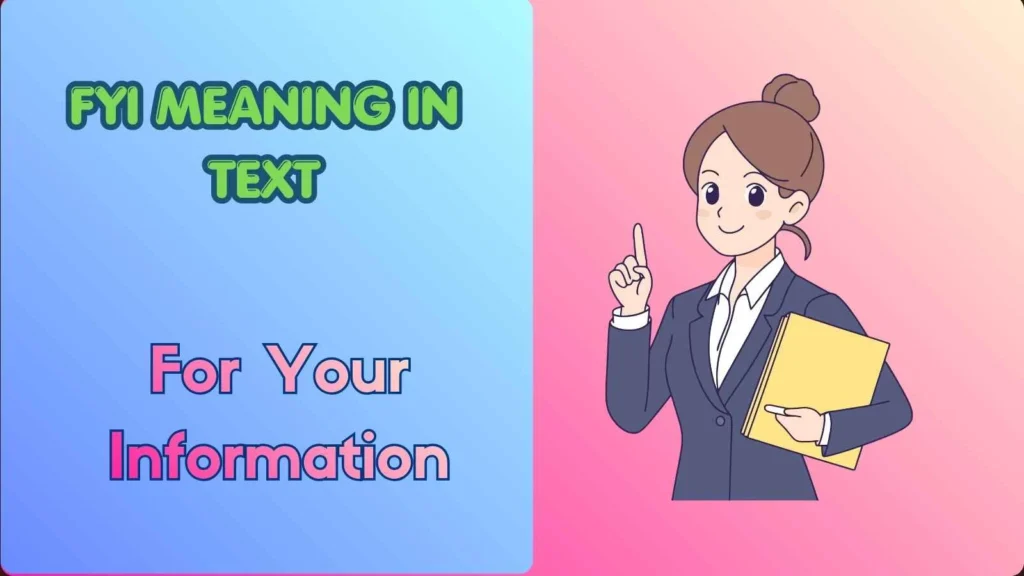
In text messages and online conversations, FYI means “For Your Information.”
People use it when they want to share information with someone without necessarily expecting a response. It acts as a quick way to say, “I thought you should know this.”
FYI is often used before providing helpful details, updates, reminders, or news.
Examples:
- FYI, the meeting starts at 3 PM.
- FYI, your package arrived today.
- FYI, the restaurant is closed on Mondays.
- FYI, I already submitted the report.
The tone of FYI depends on the situation. Most of the time, it is neutral and helpful. However, in some cases, especially in professional settings, it can sound slightly direct if not used carefully.
Quick meanings of FYI:
- Sharing information
- Giving an update
- Sending a reminder
- Providing useful details
- Informing someone without asking for action
Because it saves time and space, FYI remains popular in texting and digital communication.
Full Form, Stands For & Short Meaning of FYI
The full form of FYI is:
FYI = For Your Information
This phrase simply means that the sender is passing along information that may be useful or relevant.
Short meaning:
“I wanted to let you know.”
People often use FYI when they do not require a reply. The purpose is usually informational rather than conversational.
Examples:
- FYI, traffic is heavy today.
- FYI, your favorite show has a new season.
- FYI, the deadline was extended.
In business communication, FYI often appears in emails to provide updates.
Example:
“FYI, the client approved the proposal.”
In personal conversations, it can be more casual.
Example:
“FYI, we’re meeting at Sarah’s house tonight.”
The abbreviation works because it communicates a complete idea using only three letters.
Origin, History & First Known Use of FYI
FYI existed long before smartphones and social media.
The phrase “For Your Information” has been used in business and military communications for many decades. It was commonly written on memos, reports, and official documents to indicate information that recipients should know.
As email became popular during the 1980s and 1990s, FYI became a standard workplace abbreviation. Employees used it to share updates quickly without writing lengthy explanations.
When texting and internet chatrooms emerged, FYI naturally moved into digital conversations. Since shorter messages were preferred, abbreviations like FYI became increasingly common.
Timeline:
- Early use in official documents and memos
- Popularized in business communication
- Adopted in email culture
- Became common in texting and instant messaging
- Remains widely used across social media platforms
Today, FYI is recognized globally and understood by people of different ages and backgrounds.
How People Use FYI in Daily Conversations
People use FYI in many everyday situations. It is useful whenever someone wants to pass along information efficiently.
Common situations include:
- Sharing news
- Giving reminders
- Updating plans
- Mentioning schedule changes
- Providing helpful tips
Examples:
- FYI, the store closes at 8 PM.
- FYI, I won’t be home until later.
- FYI, your order has been shipped.
- FYI, tomorrow’s class is online.
In conversations between friends, FYI often feels casual and friendly.
Example:
“FYI 😊, everyone is meeting at the café around 6.”
In workplaces, FYI helps employees share information without creating unnecessary discussions.
Example:
“FYI, the project timeline has been updated.”
The abbreviation works because it quickly signals that important information is coming.
FYI Meaning Across WhatsApp, Instagram, TikTok & Snapchat
Although FYI means the same thing across platforms, the context may vary.
On WhatsApp, FYI is often used in group chats and personal conversations.
Examples:
- FYI, the event starts at noon.
- FYI, I sent the photos.
Users may include FYI in captions, stories, or direct messages.
Examples:
- FYI, link is in my bio.
- FYI, new content drops tomorrow.
TikTok
Creators often use FYI to introduce facts, updates, or tips.
Examples:
- FYI, this hack actually works.
- FYI, here’s what happened next.
Snapchat
On Snapchat, FYI is commonly used in chats and story replies.
Examples:
- FYI, I’m already there.
- FYI, we changed the meeting spot.
Regardless of the platform, the meaning remains consistent: sharing information with someone.
Different Meanings of FYI in Other Fields
While FYI usually means “For Your Information,” it can occasionally have different uses depending on context.
Possible meanings include:
- For Your Interest
- For Your Inspection
- For Your Involvement
However, these alternative meanings are rare.
In professional communication, legal documents, education, and social media, FYI almost always means:
For Your Information
When interpreting FYI, always consider the surrounding conversation. In most cases, the standard meaning applies.
Common Confusions, Mistakes & Wrong Interpretations
Many people misunderstand FYI because tone can be difficult to judge in text messages.
Common mistakes include:
Thinking FYI Is Rude
FYI is usually neutral, not rude.
Example:
- FYI, the report is due tomorrow.
This is simply informational.
Assuming It Requires a Reply
Most FYI messages do not require a response.
Example:
- FYI, the office will be closed Friday.
No action may be necessary.
Using It Excessively
Adding FYI to every message can feel repetitive.
Instead of:
- FYI, I’m leaving.
- FYI, I arrived.
Use it only when information truly matters.
Similar Terms, Alternatives & Related Slang
Several abbreviations have similar purposes to FYI.
Common alternatives include:
- BTW (By The Way)
- IMO (In My Opinion)
- FWIW (For What It’s Worth)
- PSA (Public Service Announcement)
- Heads up
- Just so you know
- Note that
Examples:
- Heads up, the road is closed.
- BTW, I saw your message.
- PSA: Tickets are selling fast.
Related abbreviation pages you could internally link to:
- BTW Meaning in Text
- IMO Meaning in Text
- FWIW Meaning in Text
- SMH Meaning in Text
- TBH Meaning in Text
- IDK Meaning in Text
Examples of FYI in Real Chat Situations
Here are realistic examples of FYI in action.
Friends
Friend 1: Are we still meeting tonight?
Friend 2: FYI 😊, the location changed to Jake’s house.
Family
Mom: FYI, dinner will be ready at 7.
Workplace
Manager: FYI, the client approved the budget.
School
Student: FYI, class starts 30 minutes earlier tomorrow.
Online Gaming
Player: FYI 🎮, the server will be down for maintenance.
Quick examples:
- FYI, I already paid.
- FYI, the movie starts soon.
- FYI, your package arrived.
- FYI, we’re running late.
- FYI, today’s meeting is canceled.
How to Reply When Someone Says FYI
Your response depends on the information provided.
Common replies include:
- Thanks for letting me know.
- Got it.
- Thanks!
- Good to know.
- Appreciate the update.
- Noted.
- I’ll keep that in mind.
Examples:
Message:
“FYI, the meeting was moved to Friday.”
Reply:
“Thanks for the update!”
Message:
“FYI, your order has shipped.”
Reply:
“Great, thanks!”
Many FYI messages do not require a lengthy response. A simple acknowledgment is often enough.
Is FYI Still Popular? Trends & Online Usage
Yes, FYI remains extremely popular.
Despite the rise of new slang and internet trends, FYI continues to be widely used because it is simple, clear, and universally understood.
Reasons for its popularity:
- Short and easy to type
- Professional and casual
- Recognized worldwide
- Works across all platforms
- Saves time
Modern users appreciate abbreviations that communicate information quickly. As a result, FYI remains common in emails, messaging apps, workplace communication, and social media.
Even as internet language evolves, FYI continues to be one of the most enduring abbreviations online.
Why People Use FYI Instead of Writing Full Sentences
In today’s fast-paced digital world, people prefer short and efficient communication. FYI helps users share information quickly without typing a complete sentence like “I wanted to let you know.”
Using FYI saves time while still delivering the message clearly. This is especially useful in:
- Text messages
- Workplace emails
- Team chats
- Social media conversations
- Group discussions
For example:
- FYI, the sale ends tonight.
- FYI, I already completed the task.
Because everyone understands the abbreviation, it keeps communication fast and simple.
When You Should Use FYI
FYI is most effective when you want to inform someone without sounding demanding.
Good situations include:
- Sharing updates
- Giving reminders
- Sending useful information
- Notifying someone of changes
- Providing background details
Examples:
- FYI, your appointment was moved to Tuesday.
- FYI, the restaurant now requires reservations.
- FYI, I emailed the document yesterday.
Using FYI correctly helps messages sound organized and professional.
When You Should Avoid Using FYI
Although FYI is useful, there are situations where it may not be appropriate.
Avoid using FYI when:
- Delivering serious news
- Giving emotional support
- Discussing sensitive topics
- Making formal announcements
- Communicating with people unfamiliar with abbreviations
Instead of:
- FYI, your application was rejected.
A more thoughtful response would be:
- I wanted to let you know that your application was not selected this time.
Context always matters when using internet abbreviations.
FYI in Professional Emails and Workplace Communication
FYI has become a standard part of workplace communication.
Employees often use it to:
- Share project updates
- Forward important emails
- Notify coworkers of changes
- Keep managers informed
Example email:
“FYI, the client approved the final design.”
Using FYI in business settings can reduce unnecessary explanations while ensuring everyone stays informed.
However, it should be used politely and professionally.
FYI vs BTW: What’s the Difference?
Many people confuse FYI and BTW because both abbreviations introduce information.
FYI (For Your Information)
Used to provide information the recipient should know.
Example:
- FYI, the deadline is tomorrow.
BTW (By The Way)
Used to introduce an additional thought or side comment.
Example:
- BTW, I loved your presentation.
While FYI focuses on informing, BTW focuses on adding extra conversation.
FYI vs FWIW: Understanding the Difference
Another abbreviation often confused with FYI is FWIW.
FYI
Shares information.
Example:
- FYI, the store closes at 9 PM.
FWIW (For What It’s Worth)
Shares an opinion or perspective.
Example:
- FWIW, I think the first option looks better.
The key difference is that FYI provides facts, while FWIW often introduces personal opinions.
Can FYI Sound Rude?
Sometimes yes, depending on tone and context.
For example:
- FYI, I already told you that.
This could sound annoyed or passive-aggressive.
However:
- FYI, the schedule has been updated.
Sounds neutral and helpful.
Since text messages lack facial expressions and voice tone, readers may occasionally misunderstand the sender’s intent.
To avoid confusion, many people soften FYI with friendly wording.
Examples:
- Just an FYI 😊
- FYI, thanks for checking.
- Quick FYI for everyone.
FYI in Group Chats and Team Messages
FYI is especially common in group conversations because it quickly grabs attention.
Examples:
- FYI, tonight’s event starts at 7 PM.
- FYI, parking is limited near the venue.
- FYI, we’ve changed the meeting location.
Instead of tagging every participant individually, one FYI message can inform the entire group.
This makes communication more efficient and organized.
Variations and Extended Forms of FYI
Over time, internet users have created variations of FYI.
Common examples include:
- Just FYI (JFYI)
- FYI Only
- FYI and FYA (For Your Action)
- FYI Please Note
Examples:
- Just FYI, I won’t be available this afternoon.
- FYI only, no response needed.
These versions help clarify the sender’s purpose.
FYI in Popular Culture and Internet Memes
FYI has become so common that it often appears in memes, online jokes, and viral posts.
Examples include:
- “FYI, nobody asked.” 😂
- “FYI, I’m right.”
- “Just FYI, coffee is the answer.”
Because almost everyone recognizes the abbreviation, it is frequently used for humor and sarcasm online.
How FYI Has Evolved in the Digital Age
FYI started in formal written communication but has adapted to modern internet culture.
Today, it appears in:
- Emails
- SMS messages
- WhatsApp chats
- Discord servers
- Instagram DMs
- TikTok comments
- Workplace collaboration tools
Its ability to fit both professional and casual communication is one reason it has remained popular for decades.
Fun Facts About FYI
- FYI is older than social media.
- It was commonly used in office memos before email existed.
- Millions of emails containing FYI are sent every day.
- The abbreviation is recognized internationally.
- Both teenagers and professionals use it regularly.
These facts highlight why FYI continues to be one of the most widely used abbreviations in modern communication.
FYI Meaning in Text: Key Takeaways
If you want a quick summary:
- FYI stands for For Your Information.
- It is used to share useful information.
- It usually does not require a response.
- It works in both personal and professional communication.
- It remains popular across social media and messaging apps.
- Tone and context determine whether it sounds friendly, neutral, or direct.
FAQs:
What does FYI stand for?
FYI stands for For Your Information.
Is FYI polite or rude?
FYI is generally polite and neutral. Tone depends on how it is used.
Do I need to reply to FYI messages?
Usually no, but a quick response such as “Thanks” is often appreciated.
Is FYI only used in business emails?
No. It is commonly used in texts, social media messages, group chats, and everyday conversations.
What is another way to say FYI?
Alternatives include “Heads up,” “Just so you know,” “BTW,” and “For your reference.”
Is FYI still popular in 2026?
Yes. FYI remains one of the most widely recognized and frequently used abbreviations online.
Conclusion:
FYI is a simple abbreviation that stands for For Your Information. It is used to share useful details, updates, reminders, and news without requiring a long explanation. From workplace emails to WhatsApp chats and social media conversations, FYI helps people communicate quickly and clearly.
Its meaning has remained consistent for decades, making it one of the most recognizable abbreviations in digital communication. Whether you’re receiving an FYI message or sending one yourself, understanding its purpose can help you navigate conversations with confidence.
As online communication continues to evolve, FYI remains a timeless shortcut that is unlikely to disappear anytime soon.