If you’ve ever received a simple K in a text message, you may have wondered what it really means. Is the person angry? Are they busy? Or is it simply a quick way to say “okay”?
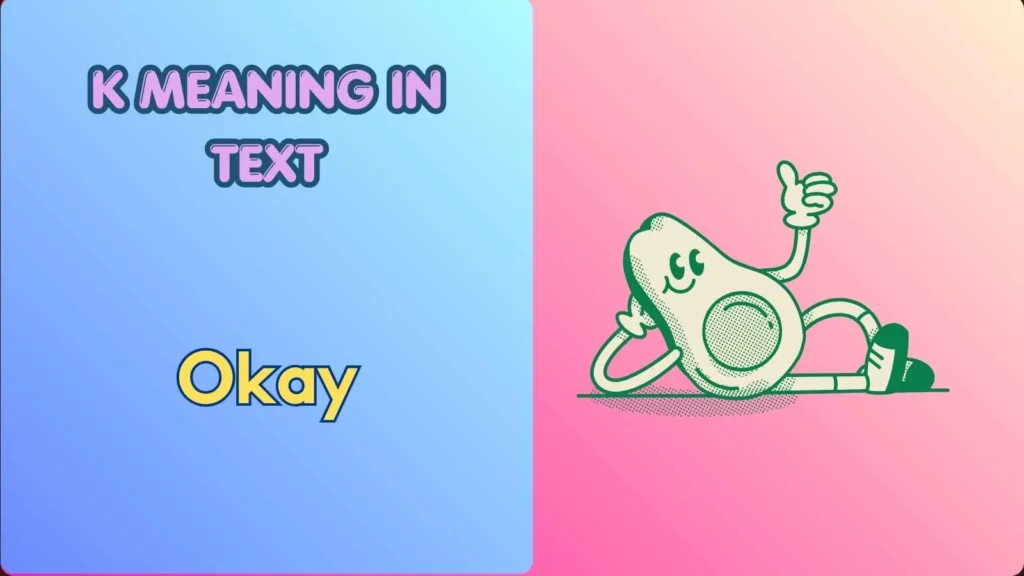
The meaning of K in text is one of the most searched texting abbreviations because it can have different meanings depending on the situation, tone, and platform. In most cases, “K” is just a shortened version of OK or Okay.
However, context matters. Sometimes it can sound friendly, while other times it may seem cold or dismissive.
As texting, social media, and instant messaging continue to shape communication, understanding abbreviations like K helps avoid misunderstandings.
This guide explains everything you need to know about K meaning in text, its origin, usage, examples, and popularity across modern digital conversations.
What Does K Mean in Text & Chat?
In text messages and online chats, K usually means “Okay.
It is one of the shortest responses people use when they want to acknowledge a message quickly. Instead of typing “okay,” “ok,” or “alright,” many people simply type “K.”
The meaning often depends on the conversation.
For example:
- “I’ll call you later.”
- “K”
In this case, it simply means the person understood the message.
However, because it is so short, some people interpret it differently. A single “K” can sometimes appear:
- Neutral
- Impatient
- Uninterested
- Busy
- Slightly annoyed
This is why context is important.
Examples:
- Friend: “Meet me at 7?”
- You: “K”
This feels normal.
But:
- Friend: “Did I do something wrong?”
- You: “K”
This may seem cold or upset.
In most situations, K is simply a quick acknowledgment rather than a negative response.
Full Form, Stands For & Short Meaning of K
Unlike many internet abbreviations, K is not technically an acronym.
Full Form
K = Okay
Short Meaning
It is a shortened version of:
- Okay
- OK
- Alright
- Understood
- Got it
People often use K because it saves time and effort while texting.
Common variations include:
- K
- kk
- Kk
- OK
- Okay
- Oki
- Okk
Each version can carry a slightly different tone.
For example:
- “K” = very brief
- “Kk” = friendlier
- “Okay!” = more enthusiastic
- “Okkk” = casual and playful
The basic meaning remains the same: agreement, acknowledgment, or understanding.
Origin, History & First Known Use of K
The use of K as a shortened form of “Okay” dates back to early online communication.
When texting became popular in the late 1990s and early 2000s, users had limited characters and slower mobile keyboards. People began shortening common words to save time.
Because “OK” was already short, many users reduced it even further to simply “K.”
The rise of:
- SMS texting
- AOL Instant Messenger
- MSN Messenger
- Yahoo Messenger
- Early chat rooms
helped popularize the abbreviation.
As smartphones evolved, K remained common because it allowed users to respond almost instantly.
Today, K is recognized worldwide and is one of the most widely used texting shortcuts across all age groups.
How People Use K in Daily Conversations
People use K in many everyday conversations.
Common situations include:
Confirming Plans
- “Dinner at 8?”
- “K”
Acknowledging Information
- “The meeting moved to Friday.”
- “K”
Ending a Conversation
- “Talk later.”
- “K”
Quick Agreement
- “Can you send the file?”
- “K”
Because it is short, K works best in casual conversations.
Some people avoid using it in professional settings because it may seem too abrupt.
Quick examples:
- “K, thanks.”
- “K see you later.”
- “K 👍”
- “K 😊”
Adding emojis often makes the response sound friendlier.
K Meaning Across WhatsApp, Instagram, TikTok & Snapchat
The meaning of K remains mostly the same across social media platforms, but tone can vary.
Usually means:
- Okay
- Got it
- Understood
Example:
- “I’ll be there soon.”
- “K”
Often used in direct messages for quick replies.
Example:
- “Send me the link.”
- “K”
TikTok
In comments and messages, K may be used casually or sarcastically depending on context.
Example:
- “That’s your opinion.”
- “K”
Snapchat
Frequently used because conversations move quickly.
Example:
- “Snap me later.”
- “K”
On social platforms, younger users may sometimes use K to express indifference or lack of interest.
Different Meanings of K in Other Fields
While K usually means “Okay” in texting, it can have different meanings elsewhere.
Mathematics
- K can represent a constant.
Science
- K stands for Kelvin, a temperature unit.
Finance
- K often means thousand.
- Example: 10K = 10,000
Gaming
- K may mean kills.
- Example: 15K score
Internet Slang
- Okay
- Understood
- Acknowledged
The meaning depends entirely on the context.
Common Confusions, Mistakes & Wrong Interpretations
Many misunderstandings happen because K is so short.
Common misconceptions include:
“K Means Someone Is Angry”
Not always.
Most people use it simply because it is fast.
“K Is Rude”
Sometimes it can seem rude, but often it is just efficient communication.
“K Always Means Okay”
Usually yes, but tone can change based on the conversation.
“K Ends Friendships”
This is a popular internet joke, but it is not true.
Tips to avoid misunderstandings:
- Use emojis 😊
- Add extra words
- Use “Okay” when discussing serious topics
Similar Terms, Alternatives & Related Slang
Several abbreviations have meanings similar to K.
Common alternatives include:
- OK
- Okay
- Okk
- Kk
- Alright
- Got it
- Sure
- Yup
- Yep
- Roger
- Sounds good
Examples:
- “OK, I’ll do it.”
- “Kk, thanks!”
- “Got it 👍”
- “Sounds good.”
These alternatives often sound warmer than a single K.
Internal Linking Suggestions
You can link to related abbreviation articles such as:
- OK Meaning in Text
- BTW Meaning in Text
- IMO Meaning in Text
- IDK Meaning in Text
- TBH Meaning in Text
- SMH Meaning in Text
- NGL Meaning in Text
- WYLL Meaning in Text
Examples of K in Real Chat Situations
Here are some realistic examples.
Example 1
- Alex: “I’ll text you after work.”
- Sam: “K”
2
- Mom: “Don’t forget groceries.”
- You: “K 👍”
3
- Friend: “Movie starts at 6.”
- You: “K see you there.”
4
- Teacher: “Submit the assignment tomorrow.”
- Student: “K”
5
- Friend: “I’m running late 😅”
- You: “K no worries 😊”
These examples show how flexible the abbreviation can be.
How to Reply When Someone Says K
The best response depends on the conversation.
Possible replies include:
- “Great!”
- “Sounds good.”
- “Thanks.”
- “See you then.”
- “Got it.”
- “Perfect.”
Examples:
- Them: “K”
- You: “Awesome 😊”
Or:
- Them: “K”
- You: “Thanks for letting me know.”
Usually, no special response is required because K already acknowledges the message.
Is K Still Popular? Trends & Online Usage
Yes, K remains extremely popular.
Even though newer slang terms appear every year, K continues to be widely used because it is:
- Fast
- Easy
- Universal
- Recognized globally
Many younger users now prefer:
- Kk
- Okk
- Okayyy
- Bet
- Gotcha
However, K is still common across:
- Text messages
- Snapchat
- Facebook Messenger
- Online gaming chats
Its simplicity ensures that it remains part of everyday digital communication.
Why Do People Use K Instead of Okay?
The biggest reason people use “K” is convenience. In fast-paced digital conversations, users often prefer the shortest possible response. A single letter can acknowledge a message without requiring extra typing.
Other reasons include:
- Faster texting
- Informal communication style
- Habit developed from SMS culture
- Quick acknowledgment during busy moments
- Popularity among younger users
While some people view it as efficient, others may perceive it as overly brief depending on the situation.
Is K Considered Rude or Passive-Aggressive?
One of the most debated questions online is whether “K” sounds rude. The answer depends heavily on context, relationship, and tone.
Situations where K may seem rude:
- During an argument
- After a long emotional message
- When used without explanation
- When someone expected a detailed reply
Situations where K is usually harmless:
- Confirming plans
- Responding while busy
- Casual conversations between close friends
- Group chats
The same letter can sound completely different depending on the conversation.
Difference Between K, KK, Kk, and Okay
Although these responses share similar meanings, they can create different impressions.
K
Very short and direct.
KK
Friendlier and more casual.
Kk
Common among younger users and often feels warmer.
Okay
More professional and polite.
Okayyy
Adds enthusiasm or excitement.
Choosing the right version depends on the tone you want to convey.
How Different Age Groups Interpret K
Not everyone views “K” the same way.
Teenagers and Young Adults
Younger users may sometimes interpret a lone “K” as cold, annoyed, or uninterested.
Millennials
Many millennials grew up with SMS messaging and often see K as a normal shorthand.
Older Adults
Older users usually view K simply as a shortened form of “Okay.”
Because generational perceptions differ, misunderstandings can occasionally occur.
K in Professional and Workplace Communication
While K is common among friends, it may not always be suitable in professional settings.
Instead of replying with:
- K
Consider using:
- Okay
- Understood
- Sounds good
- Thank you
- Noted
These alternatives appear more professional and reduce the chance of sounding dismissive.
When You Should Avoid Using K
There are situations where using a single-letter response may create confusion.
Avoid using K when:
- Discussing sensitive topics
- Responding to customer inquiries
- Handling workplace communication
- Talking about emotional issues
- Giving important instructions
In these cases, a more detailed response helps maintain clarity and respect.
Body Language of Digital Communication: What K Really Signals
Since text messages lack facial expressions and voice tone, people often assign emotional meaning to short replies.
A message like “K” can signal:
- Agreement
- Acknowledgment
- Limited availability
- End of discussion
- Lack of interest (in some cases)
This phenomenon shows how even one letter can carry different emotional interpretations online.
Funny Memes and Internet Jokes About K
The internet has created countless jokes about receiving a single “K” message.
Popular meme themes include:
- “Getting a K after sending a paragraph.”
- “When she replies with K.”
- “The most terrifying text message ever: K.”
These jokes exaggerate the idea that K automatically means someone is upset, even though that is often untrue.
K vs Other Popular Texting Abbreviations
Many internet abbreviations serve a similar purpose.
| Abbreviation | Meaning |
|---|---|
| K | Okay |
| OK | Okay |
| KK | Okay, understood |
| IDK | I don’t know |
| TBH | To be honest |
| BTW | By the way |
| IMO | In my opinion |
| NGL | Not gonna lie |
Understanding these abbreviations helps users communicate more effectively online.
Cultural Differences in the Use of K
The interpretation of K can vary across countries and cultures.
In some regions, people frequently use short responses and see them as normal. In other cultures, longer replies may be expected as a sign of politeness.
As global communication becomes more common through social media and messaging apps, understanding these differences helps prevent misunderstandings.
Psychology Behind Short Text Responses
Researchers studying digital communication have found that people often assign emotional meaning to message length.
Long responses may appear:
- Friendly
- Interested
- Engaged
Very short responses like K may appear:
- Neutral
- Busy
- Detached
However, these perceptions are not always accurate. The sender may simply be multitasking or responding quickly.
Future of K in Online Communication
Despite constant changes in internet slang, K has survived for decades.
Its future remains strong because:
- It is universally recognized.
- It works across platforms.
- It is easy to type.
- It transcends language barriers.
While new slang terms emerge every year, K remains one of the simplest and most enduring responses in digital communication.
Quick Facts About K
- K is one of the shortest text responses possible.
- It usually means “Okay.”
- It became popular during the SMS era.
- It is widely used on WhatsApp, Instagram, Snapchat, and TikTok.
- Context determines whether it sounds friendly or cold.
- It remains popular across multiple generations.
- It is recognized in most English-speaking countries.
FAQs:
What does K mean in texting?
K usually means “Okay” or “I understand.”
Is K rude in a text message?
Not necessarily. It depends on the tone and context of the conversation.
What is the difference between K and OK?
Both mean the same thing, but K is shorter and may sometimes appear less friendly.
Why do people reply with only K?
People often use it when they want to respond quickly or acknowledge a message.
What does K mean on Snapchat?
On Snapchat, K generally means “Okay” or “Got it.”
Does K mean someone is angry?
Not always. Most of the time it is simply a quick response.
Is K still used in 2026?
Yes. It remains one of the most common text abbreviations worldwide.
Conclusion
The meaning of K in text is usually simple: it means “Okay.” Despite being only one letter, it plays a huge role in modern digital communication. People use it to confirm plans, acknowledge messages, and keep conversations moving quickly.
However, because K is so brief, its tone can sometimes be interpreted differently depending on the context. In casual chats, it is usually harmless and convenient. In more serious conversations, using a longer response like “Okay” or “Got it” can help avoid misunderstandings.
Whether you’re texting friends, chatting on WhatsApp, messaging on Instagram, or using Snapchat, understanding how K is used can help you communicate more clearly and confidently in today’s online world.