The term nonchalant is a popular English word used to describe someone who appears calm, relaxed, and unconcerned, even in situations where others might feel nervous or excited. Many people search for the nonchalant definition because they see the word on social media, in conversations, books, movies, or online discussions and want to understand its true meaning.
In recent years, the word has become especially common on platforms like TikTok, Instagram, and Snapchat, where users often describe someone’s attitude as “nonchalant.” While the term may sound simple, it can have different meanings depending on the context.
This guide explains everything you need to know about the nonchalant definition, including its origin, history, usage in text messages, examples, social media trends, common misunderstandings, and related terms. By the end, you’ll know exactly how and when to use this word correctly.
What Does Nonchalant Mean in Text & Chat?
In text messages and online chats, nonchalant describes a person who seems calm, cool, and unaffected by events or emotions.
Someone acting nonchalant may appear as though nothing bothers them. They do not show strong reactions, even when something important happens.
For example:
- “He was so nonchalant after winning the game.”
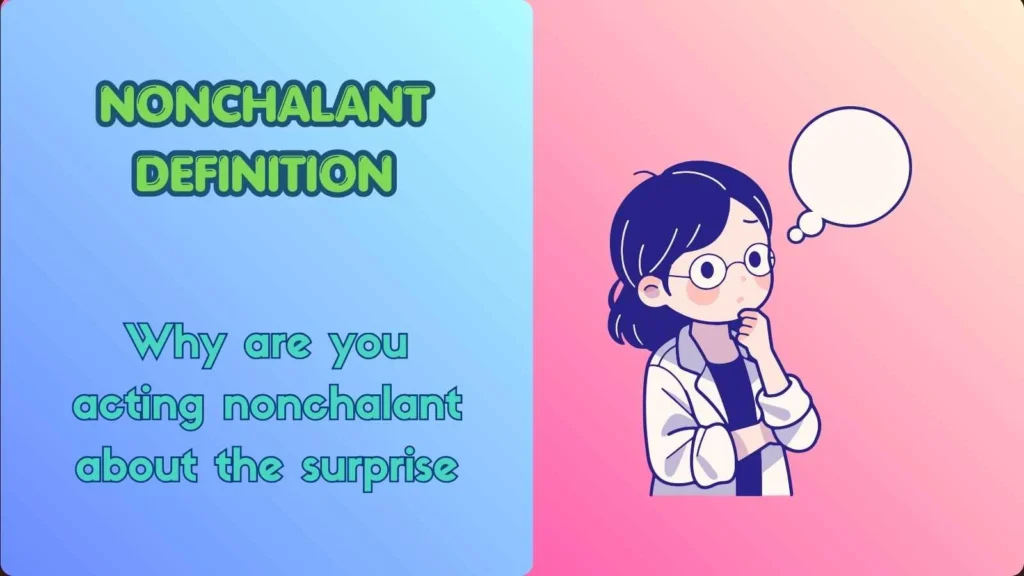
- “Why are you acting nonchalant about the surprise?”
- “She replied with a simple ‘okay’ and sounded completely nonchalant.”
In online conversations, the word can be used positively or negatively.
Positive meaning:
- Confident
- Relaxed
- Composed
Negative meaning:
- Emotionally distant
- Uninterested
- Too casual
Many social media users use the word when describing people who seem difficult to impress or who avoid showing excitement.
Full Form, Stands For & Short Meaning of Nonchalant
Unlike internet abbreviations, nonchalant is not an acronym and does not have a full form.
Short Meaning
Nonchalant = Calm, relaxed, and seemingly unconcerned
The word describes an attitude rather than a phrase or abbreviation.
Quick definitions:
- Calm under pressure
- Not easily excited
- Appearing unconcerned
- Casual and relaxed
- Unaffected by events
Examples:
- “She stayed nonchalant during the interview.”
- “His nonchalant attitude surprised everyone.”
- “They looked nonchalant despite the chaos.”
Because many people are familiar with internet slang, they sometimes assume nonchalant stands for something. However, it is simply a regular English adjective with a long history.
Origin, History & First Known Use of Nonchalant
The word nonchalant comes from the French language.
It originated from the French word nonchaloir, which means “to disregard” or “to not be concerned.”
Historical Development
- Originated in French
- Entered English during the 18th century
- Became widely used in literature and formal writing
- Later expanded into everyday speech
The first known English uses appeared in the 1700s. Writers used the term to describe characters who seemed calm and unconcerned.
Over time, the word became part of everyday vocabulary. Today, it is commonly used in casual conversations, social media captions, movies, and online discussions.
Its popularity has increased again because younger generations frequently discuss “nonchalant behavior” on social platforms.
How People Use Nonchalant in Daily Conversations
People use nonchalant when describing attitudes, reactions, and personalities.
The word is often used when someone appears emotionally controlled or unusually relaxed.
Common examples include:
- A student staying calm before an exam
- An athlete remaining cool during a competition
- A friend acting casual after receiving exciting news
- Someone pretending not to care about a situation
Conversation examples:
B: “Yeah, it’s nice.”
A: “Why are you so nonchalant about it?”
B: “Not really.”
Person A: “You’re surprisingly nonchalant.”
Quick examples:
- “He remained nonchalant during the storm.”
- “Her nonchalant response confused everyone.”
- “I wish I could stay that nonchalant.”
The word often highlights a contrast between expected excitement and actual calmness.
Nonchalant Meaning Across WhatsApp, Instagram, TikTok & Snapchat
Social media has given the word nonchalant a fresh cultural meaning.
On WhatsApp, people use nonchalant to describe someone who:
- Replies late
- Gives short answers
- Appears emotionally detached
- Stays calm during arguments
Example:
- “He’s so nonchalant in chats.”
Instagram users often use the term in captions and comments.
Examples:
- “Keeping it nonchalant.”
- “Nonchalant but observant.”
- “Mastering the nonchalant vibe.”
TikTok
TikTok has significantly boosted the popularity of the word.
Many videos discuss:
- Nonchalant men
- Nonchalant relationships
- Nonchalant personality traits
- How to stop being nonchalant
Example:
- “Why are all the nonchalant people impossible to read?”
Snapchat
On Snapchat, the word often refers to someone who:
- Leaves messages unopened
- Responds casually
- Avoids showing emotions
Example:
- “She’s acting nonchalant again 😅”
Different Meanings of Nonchalant in Other Fields
Although nonchalant generally means calm and unconcerned, the exact interpretation can vary.
Psychology
May describe someone who appears emotionally controlled.
Literature
Used to portray cool, composed characters.
Fashion
Can describe a relaxed and effortless style.
Example:
- “A nonchalant fashion look.”
Business
May refer to a calm approach during stressful situations.
Example:
- “The manager remained nonchalant throughout the crisis.”
Entertainment
Often used to describe confident or mysterious personalities.
Each context keeps the core meaning of appearing unconcerned or relaxed.
Common Confusions, Mistakes & Wrong Interpretations
Many people misunderstand the word nonchalant.
Mistake 1: Thinking It Means Lazy
Nonchalant does not necessarily mean lazy.
Correct:
- Calm and relaxed
Incorrect:
- Unproductive or unwilling to work
Mistake 2: Assuming It Means Rude
A nonchalant person is not automatically rude.
They may simply show fewer emotions.
Mistake 3: Confusing It with Confidence
Confidence and nonchalance can overlap, but they are different.
Confidence:
- Belief in one’s abilities
Nonchalance:
- Lack of visible concern
Mistake 4: Treating It as Slang
Although popular online, nonchalant is a standard English word, not internet slang.
Understanding these differences helps avoid misuse.
Similar Terms, Alternatives & Related Slang
Several words share a similar meaning with nonchalant.
Synonyms
- Relaxed
- Calm
- Casual
- Cool
- Composed
- Unconcerned
- Easygoing
- Collected
- Laid-back
- Unbothered
Related Slang
- Chill
- Cool
- Low-key
- Unbothered
- No stress
Examples:
- “He’s very chill.”
- “She’s completely unbothered.”
- “They stayed cool under pressure.”
These alternatives can often replace nonchalant depending on the situation.
Examples of Nonchalant in Real Chat Situations
Here are realistic chat examples.
Example 1
Alex: “You won first place!” 🎉
Sam: “Nice.”
Alex: “Why are you so nonchalant?”
Example 2
Emma: “Aren’t you excited for tomorrow?” 😃
Jake: “A little.”
Emma: “That’s a very nonchalant response.”
Example 3
Mia: “Everyone was panicking.”
Liam: “I wasn’t worried.”
Mia: “You were incredibly nonchalant.”
Example 4
Sarah: “Did you see the surprise?” 🎁
Ben: “Yeah, it was cool.”
Sarah: “You’re way too nonchalant.”
These examples show how the word is commonly used in everyday conversations.
How to Reply When Someone Says Nonchalant
If someone calls you nonchalant, your response depends on the situation.
Friendly replies:
- “I guess I stay calm.”
- “I’m just relaxed.”
- “That’s my personality.”
- “I’m trying not to overreact.”
Funny replies:
- “Panic isn’t my hobby. 😎”
- “I’m professionally nonchalant.”
- “Someone has to stay cool.”
Serious replies:
- “I care more than it looks.”
- “I just don’t show emotions easily.”
- “I’m thinking before reacting.”
Choosing the right reply depends on the tone of the conversation.
Is Nonchalant Still Popular? Trends & Online Usage
Yes, nonchalant remains highly popular.
The term has gained new attention because of:
- TikTok trends
- Relationship discussions
- Personality analysis videos
- Social media memes
- Online dating conversations
Modern internet culture frequently discusses whether being nonchalant is attractive, healthy, or frustrating in relationships.
Many users now describe themselves as:
- Nonchalant
- Too nonchalant
- Recovering from being nonchalant
- Trying to be less nonchalant
As a result, the word continues to trend across social platforms and online communities.
Internal Linking Suggestions
For better SEO and user engagement, consider linking to related articles such as:
- Chill Meaning in Text
- BTW Meaning in Text
- IMO Meaning in Text
- Low-Key Meaning Explained
- Unbothered Meaning in Slang
- Dry Texter Meaning
- Ghosting Meaning in Text
- Casual Conversation Slang Guide
FAQs:
What is the simple definition of nonchalant?
Nonchalant means appearing calm, relaxed, and unconcerned, especially in situations where others might react emotionally.
Is nonchalant a positive or negative word?
It can be either. Some people see it as confidence and calmness, while others view it as emotional distance or lack of interest.
Does nonchalant mean careless?
Not necessarily. A nonchalant person may still care deeply but choose not to show strong emotions.
Is nonchalant the same as unbothered?
They are similar, but unbothered specifically emphasizes not being affected, while nonchalant focuses on appearing relaxed and unconcerned.
Why is nonchalant popular on TikTok?
TikTok users often discuss nonchalant behavior in friendships, dating, and relationships, making the term widely used in videos and comments.
Can someone be naturally nonchalant?
Yes. Some people naturally have calm personalities and show fewer emotional reactions than others.
Conclusion:
Understanding the nonchalant definition is easier once you know its core meaning: appearing calm, relaxed, and unconcerned. The word has roots in French history, yet it remains highly relevant in modern conversations, social media, and everyday communication.
Whether you’re reading a book, scrolling through TikTok, chatting on WhatsApp, or talking with friends, you’ll likely encounter this term regularly. While nonchalant behavior can sometimes be mistaken for disinterest, it often simply reflects a composed personality.
By learning its meaning, origin, common uses, and real-life examples, you can confidently recognize and use the word in the right context.