If you’ve received a message that simply says NTY, you may have wondered what it means. Text abbreviations are everywhere today, from casual chats and group conversations to social media comments and direct messages.
People use short forms to save time, type faster, and keep conversations simple.
One abbreviation that often appears in texting is NTY. While it looks short and straightforward, many people search for its meaning because they are unsure whether it is polite, rude, friendly, or something else entirely.
Understanding the meaning of NTY can help you avoid confusion and communicate more effectively online.
In this guide, you’ll learn what NTY means in text messages, where it came from, how people use it on social media platforms, common mistakes people make, and examples of how to reply when someone sends it.
What Does NTY Mean in Text & Chat?
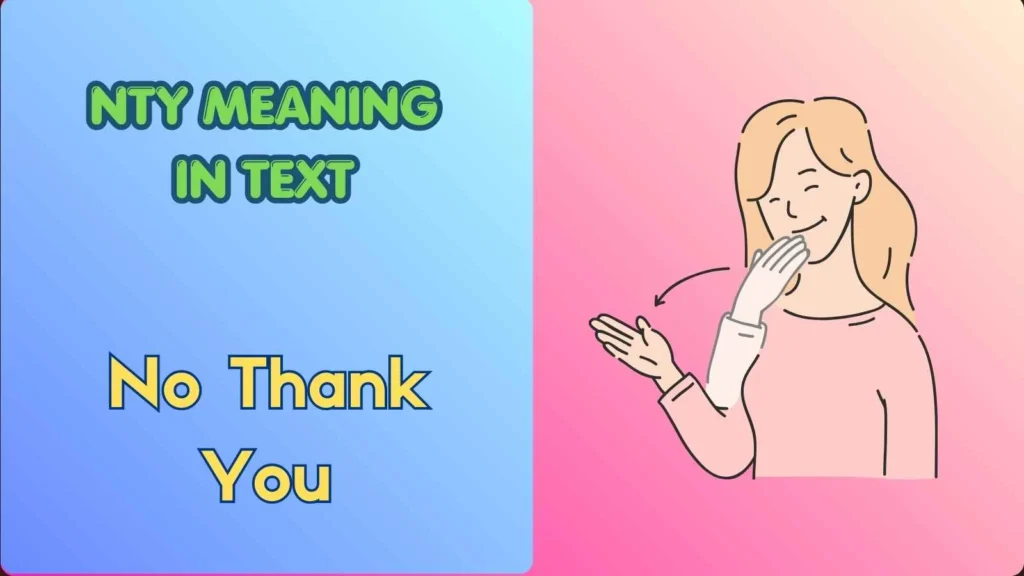
In texting and online conversations, NTY usually means “No Thank You.”
People use it as a short and polite way to decline an offer, invitation, suggestion, or request. Instead of typing the full phrase, they simply write NTY.
For example:
- “Want to join us for dinner?”
- “NTY, I already ate.”
The abbreviation helps keep conversations quick while still sounding respectful.
NTY is generally considered more polite than replying with a simple “No.” Adding the “thank you” part shows appreciation even when turning something down.
Quick examples:
- Want another slice of pizza?” → “NTY 😊
- “Can you work this weekend?” → “NTY.”
- “Interested in buying this?” → “NTY, but thanks.”
In most situations, NTY is friendly and not intended to offend anyone.
Full Form, Stands For & Short Meaning of NTY
The full form of NTY is:
N = No
T = Thank
Y = You
So the complete phrase is:
NTY = No Thank You
Short meaning:
- Politely declining something
- Refusing an offer
- Saying no respectfully
- Showing appreciation while rejecting a suggestion
People often use NTY because it is:
- Fast to type
- Easy to understand
- Friendly in tone
- Common in digital communication
Alternative ways people write the same idea include:
- No thanks
- Nah, thanks
- Thanks, but no thanks
- Appreciate it, but no
- I’ll pass
Although NTY is brief, its meaning is usually clear from the conversation context.
Origin, History & First Known Use of NTY
Like many internet abbreviations, NTY emerged as online communication became faster and more mobile-focused.
During the early days of chat rooms, instant messaging services, and SMS texting, users began shortening common phrases to save time and character space. Expressions such as:
- LOL
- BRB
- TY
- IMO
became widely accepted.
NTY followed the same pattern. Since “No Thank You” is a phrase people use frequently, shortening it into NTY was a natural development.
There is no single documented creator of NTY. Instead, it appears to have evolved organically through online communities and text messaging culture.
As smartphones became popular, abbreviations like NTY continued spreading across:
- SMS messages
- Online forums
- Gaming chats
- Social media platforms
- Workplace messaging apps
Today, NTY remains a recognizable abbreviation, especially among people who frequently communicate online.
How People Use NTY in Daily Conversations
NTY is mainly used when declining something politely.
Common situations include:
Declining Invitations
- “Want to come to the party?”
- “NTY, I have plans.”
Refusing Offers
- “Need help carrying that?”
- “NTY, I’ve got it.”
Rejecting Suggestions
- “You should watch this movie.”
- “NTY, it doesn’t look like my style.”
Turning Down Requests
- “Can you cover my shift?”
- “NTY, I’m busy that day.”
People choose NTY because it avoids sounding harsh.
Compare:
- “No.”
- “NTY.”
The second response feels more respectful and friendly.
Many users also add emojis to soften the tone:
- NTY 😊
- NTY ❤️
- NTY 🙏
These small additions help maintain a positive conversation.
NTY Meaning Across WhatsApp, Instagram, TikTok & Snapchat
While the meaning stays mostly the same, the way NTY is used can vary across platforms.
On WhatsApp, NTY is commonly used in personal chats and family groups.
Example:
- Want me to pick up food?”
- “NTY, I already ordered.”
People may use NTY in direct messages or comment sections.
Example:
- “Check out my product!”
- “NTY.”
TikTok
TikTok users often use NTY in comments when responding to trends, recommendations, or challenges.
Example:
- “Everyone should try this challenge.”
- “NTY 😂”
Snapchat
On Snapchat, NTY is frequently used in casual conversations between friends.
Example:
- “Want to streak today?”
- “NTY 😅”
Across all platforms, the meaning remains “No Thank You.”
Different Meanings of NTY in Other Fields
Although “No Thank You” is the most common meaning, NTY can occasionally have different meanings depending on context.
Possible alternative uses include:
- Company abbreviations
- Project codes
- Internal business terms
- Usernames or gaming tags
However, in texting and social media conversations, No Thank You is overwhelmingly the most common interpretation.
When reading NTY, always consider:
- Who sent it
- Where it appeared
- What the conversation was about
Context helps determine the intended meaning.
Common Confusions, Mistakes & Wrong Interpretations
Many people misunderstand NTY when they first encounter it.
Common mistakes include:
Thinking It Means “Not You”
Some users assume NTY stands for “Not You.”
In most texting situations, this is incorrect.
Assuming It Is Rude
Because NTY is short, some people think it sounds cold.
In reality, it is usually intended to be polite.
Confusing It With TY
TY means:
Thank You
NTY means:
No Thank You
The extra “N” changes the meaning completely.
Reading It Without Context
Abbreviations often depend on surrounding messages. Reading NTY alone can sometimes create confusion.
Always look at the conversation before interpreting it.
Similar Terms, Alternatives & Related Slang
Several abbreviations and phrases carry similar meanings.
Common alternatives include:
- TY = Thank You
- NVM = Never Mind
- IDC = I Don’t Care
- NP = No Problem
- TBH = To Be Honest
Similar full phrases:
- No thanks
- I’ll pass
- Maybe next time
- Not interested
- Thanks anyway
- Appreciate the offer
Internal linking suggestions:
- TY Meaning in Text
- NVM Meaning in Text
- TBH Meaning in Text
- IMO Meaning in Text
- BRB Meaning in Text
- IDC Meaning in Text
These related abbreviations often appear in the same types of conversations.
Examples of NTY in Real Chat Situations
Here are some realistic examples.
Example 1
Friend: “Want to play a game tonight?”
You: “NTY, I’m tired 😴”
Example 2
Coworker: “Can you take my shift tomorrow?”
You: “NTY, I already have plans.”
Example 3
Family Member: “Would you like more cake?”
You: “NTY 😊”
Example 4
Online Seller: “Interested in buying this item?”
You: “NTY, thanks.”
Example 5
Friend: “Want to go shopping later?”
You: “NTY, maybe another day.”
These examples show how NTY helps keep responses brief and polite.
How to Reply When Someone Says NTY
When someone responds with NTY, the best approach is to respect their decision.
Possible replies include:
- “No problem!”
- “Thanks for letting me know.”
- “Maybe next time.”
- “All good.”
- “I understand.”
Examples:
Person A: “Want to join us?”
B: “NTY.”
Person A: “No worries!”
Or:
Person A: “Need help?”
B: “NTY 😊”
Person A: “Okay, just let me know if you change your mind.”
A friendly response keeps the conversation comfortable.
Is NTY Still Popular? Trends & Online Usage
Yes, NTY is still used today, although it is not as famous as abbreviations like:
- LOL
- OMG
- BRB
Its popularity comes from its usefulness. People regularly need a quick way to decline offers politely.
Reasons NTY remains relevant:
- Easy to type
- Clear meaning
- Polite tone
- Works across platforms
- Suitable for personal and professional chats
While some people prefer typing “No thanks” in full, NTY continues to appear in text messages, social media comments, online communities, and messaging apps.
As digital communication evolves, practical abbreviations like NTY are likely to remain part of internet culture.
Why Do People Use NTY Instead of Writing “No Thank You”?
Modern online communication values speed and convenience. Many users prefer abbreviations because they allow them to respond quickly without typing complete sentences. NTY saves time while still maintaining politeness.
People often choose NTY because:
- It is short and efficient.
- It communicates respect.
- It works in both casual and semi-formal chats.
- Most frequent texters understand it instantly.
For example:
- “Want to join the video call?”
- “NTY, maybe next time.”
Using NTY helps people decline offers without sounding abrupt or unfriendly.
Is NTY Polite or Rude?
One of the most common questions people have is whether NTY sounds rude.
In most cases, NTY is considered polite because it includes the phrase “thank you.” The sender is not simply rejecting an offer; they are also acknowledging it.
The tone can depend on:
- The relationship between the people chatting.
- The surrounding conversation.
- Whether additional words or emojis are included.
Examples:
- “NTY 😊” → Friendly
- “NTY, thanks anyway.” → Very polite
- “NTY.” → Neutral
Generally, NTY is viewed as a respectful response.
When Should You Avoid Using NTY?
Although NTY works well in casual conversations, it may not always be the best choice.
Situations where writing the full phrase is better include:
- Professional emails
- Job interviews
- Formal business communication
- Academic discussions
- Customer service interactions
For example:
Instead of:
- “NTY”
You could write:
- “No thank you, I appreciate the offer.”
The full phrase appears more professional and thoughtful.
NTY vs No Thanks: What’s the Difference?
Both expressions mean nearly the same thing, but there are subtle differences.
NTY
- Shorter
- Mostly used online
- Common in texting
- Informal
No Thanks
- More natural in speech
- Suitable for online and offline communication
- Slightly warmer in tone
- Easier for all age groups to understand
Example:
- “Want another drink?”
- “NTY.”
or
- “No thanks.”
Both are acceptable and polite.
How NTY Is Used in Online Gaming Communities
Gamers frequently use abbreviations to communicate quickly during matches and team activities.
NTY often appears when players decline:
- Team invitations
- Clan requests
- Trade offers
- Voice chat requests
- Multiplayer game invitations
Examples:
- “Join our squad?”
- “NTY.”
- “Want to trade items?”
- “NTY, I’m good.”
Because gaming environments move quickly, abbreviations like NTY fit naturally into conversations.
How Parents and Older Generations Interpret NTY
Not everyone is familiar with internet slang.
Older users who are less active on social media may initially misunderstand NTY. Some might think it is a typo or an unfamiliar acronym.
This generational gap is common with many internet abbreviations.
Younger users typically recognize NTY immediately because they regularly encounter similar shorthand such as:
- LOL
- BRB
- IDK
- TBH
As digital communication becomes more common, understanding abbreviations like NTY is becoming increasingly important across all age groups.
Emotional Tone Behind NTY
The emotional tone of NTY can vary depending on context.
Possible tones include:
Friendly
- “NTY 😊”
Respectful
- “NTY, but thanks for asking.”
Playful
- “NTY 😂 I don’t think I could survive that challenge.”
Firm
- “NTY. I’ve already made my decision.”
Context and punctuation play a major role in how the message is interpreted.
Most Common Situations Where You’ll See NTY
NTY appears in many everyday situations.
Common examples include:
- Declining party invitations
- Refusing product offers
- Rejecting sales messages
- Turning down dates
- Skipping online challenges
- Saying no to additional food
- Rejecting gaming requests
- Declining social media collaborations
Because people frequently need a polite way to refuse something, NTY remains useful across many types of conversations.
Can NTY Be Used Sarcastically?
Yes, although this is less common.
Like many text expressions, NTY can sometimes be used sarcastically when the context is clearly humorous.
Example:
Friend: “Want to wake up at 5 AM and run 10 miles?”
Reply:
- “NTY 😂”
In this case, the sender is jokingly rejecting the suggestion.
The emoji helps show that the message is playful rather than serious.
The Future of NTY in Internet Slang
Internet language constantly evolves. Some abbreviations disappear while others remain popular for decades.
NTY has several advantages that help it stay relevant:
- Easy to remember
- Easy to type
- Clear meaning
- Polite tone
- Useful in everyday conversations
Even as new slang terms emerge on platforms like TikTok and Snapchat, NTY continues to serve a practical purpose. Because people frequently need a quick and respectful way to say no, the abbreviation is likely to remain part of online communication for years to come.
NTY at a Glance (Quick Summary)
| Term | Meaning |
|---|---|
| NTY | No Thank You |
| Category | Texting Abbreviation |
| Tone | Polite |
| Usage | Declining Offers |
| Common Platforms | WhatsApp, Instagram, TikTok, Snapchat |
| Formality | Informal |
| Popularity | Still Common |
FAQs:
What does NTY mean in texting?
NTY stands for “No Thank You.” It is a polite way to decline an offer or invitation.
Is NTY rude?
No. NTY is generally considered polite because it includes “thank you” while saying no.
What is the full form of NTY?
The full form is No Thank You.
Can NTY be used in professional messages?
Yes. It can be used in casual workplace chats, though writing “No thank you” in full may appear more professional.
Is NTY commonly used on Snapchat?
Yes. Many Snapchat users use NTY as a quick way to politely refuse something.
What’s the difference between TY and NTY?
TY means Thank You, while NTY means No Thank You.
Can NTY have other meanings?
In some specialized contexts, it may represent other terms, but in texting it almost always means No Thank You.
Conclusion
NTY is a simple but useful text abbreviation that stands for “No Thank You.” It allows people to decline invitations, offers, suggestions, or requests while remaining polite and respectful.
Whether you’re chatting on WhatsApp, Instagram, TikTok, Snapchat, or through regular text messages, NTY helps keep conversations short and friendly.
Understanding abbreviations like NTY makes online communication easier and prevents misunderstandings. While it may not be as famous as LOL or OMG, it remains a practical expression that many internet users recognize instantly.
The next time you see NTY in a message, you’ll know exactly what it means and how to respond appropriately.