If you spend time texting, chatting online, or scrolling through social media, you’ve probably seen the term ETC used in messages, comments, and posts.
Many people search for ETC meaning in text because they want to understand what it means, when to use it, and whether it is appropriate in casual conversations.
ETC is one of the most common abbreviations in the English language. Unlike many internet slang terms that come and go, ETC has been around for centuries and continues to be used in modern texting, emails, social media posts, and everyday communication.
It helps people save time by avoiding long lists while still getting their point across.
In this guide, you’ll learn the meaning of ETC in text, its full form, history, usage examples, social media meanings, common mistakes, and much more.
What Does ETC Mean in Text & Chat?
In text messages and online chats, ETC means “and other similar things” or “and so on.
People use it when they don’t want to list every item in a group. Instead of writing a complete list, they add ETC at the end to show that more related items exist.
For example:
- We need bread, milk, eggs, etc.
- Bring your phone charger, headphones, etc.
- I enjoy movies, games, books, etc.
In texting, ETC is a quick way to keep messages short while still communicating the main idea.
Short chat examples:
- “I bought snacks, drinks, etc. for the trip.”
- “We talked about work, travel, etc.”
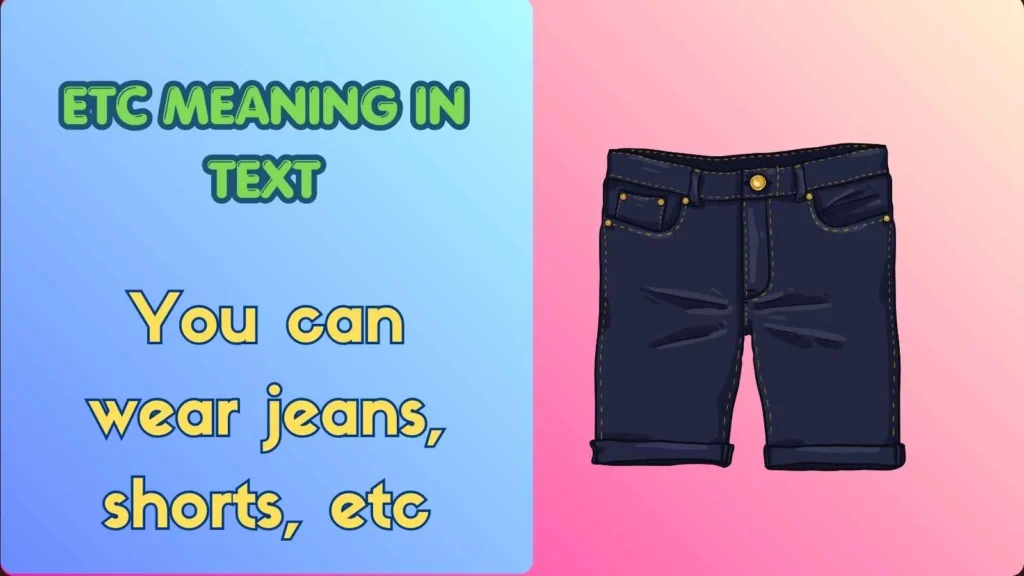
- “You can wear jeans, shorts, etc. 😊”
The abbreviation is understood by people of all ages, making it one of the safest and most widely recognized shorthand expressions online.
Full Form, Stands For & Short Meaning of ETC
The full form of ETC is:
Et Cetera
This phrase comes from Latin and literally means:
“And the rest” or “And other things.”
When people write ETC, they are referring to additional items that belong to the same category as the things already mentioned.
For example:
- Pens, pencils, markers, etc.
- Dogs, cats, rabbits, etc.
- Facebook, Instagram, TikTok, etc.
Simple breakdown:
- ETC = Et Cetera
- Meaning = And so on
- Usage = Used after a list
Many people write it as:
- etc.
- ETC
- Etc.
The most grammatically correct form is usually etc. with a period because it is an abbreviation.
Quick meanings:
- And so on
- And others
- And similar things
- The rest of the list
Because it is easy to understand and widely accepted, ETC remains one of the most frequently used abbreviations in both formal and informal communication.
Origin, History & First Known Use of ETC
ETC has a surprisingly long history.
The term comes from the Latin phrase et cetera, where:
- Et = And
- Cetera = The remaining things
The phrase has been used for hundreds of years in books, documents, and scholarly writing.
Originally, ETC appeared in formal writing where authors needed a concise way to indicate that a list continued beyond the examples provided.
Over time, the phrase spread into everyday English. As communication evolved, people began using the shortened form “etc.” in letters, business documents, newspapers, and eventually digital communication.
When texting and internet messaging became popular, ETC naturally moved into chats and social media posts because it helped users write shorter messages.
Timeline:
- Ancient Latin origins
- Adopted into English writing centuries ago
- Common in books and formal documents
- Became popular in emails
- Widely used in texts and social media today
Unlike many modern abbreviations, ETC did not start online. It existed long before the internet and successfully adapted to digital communication.
How People Use ETC in Daily Conversations
People use ETC whenever they want to avoid listing every possible item.
It appears in:
- Text messages
- Emails
- School assignments
- Social media posts
- Work chats
- Everyday conversations
Examples:
- “I need vegetables like carrots, potatoes, onions, etc.”
- “We’ll discuss marketing, sales, budgeting, etc.”
- “She likes action movies, comedies, thrillers, etc.”
Common situations:
Making Lists
- Books, magazines, newspapers, etc.
Giving Examples
- Apps like Instagram, TikTok, etc.
Saving Time
- Instead of naming ten items, people simply add ETC.
- Friend: “What should I bring?”
- You: “Snacks, water, sunscreen, etc.”
- Friend: “What games do you play?”
- You: “Minecraft, Roblox, Fortnite, etc. 🎮”
The abbreviation makes conversations faster and easier while still conveying complete meaning.
ETC Meaning Across WhatsApp, Instagram, TikTok & Snapchat
The meaning of ETC stays mostly the same across social media platforms.
People use ETC in casual chats.
Example:
- “Bring chips, drinks, etc. for the party.”
Users often add ETC in captions.
Example:
- “Travel, food, photography, etc. are my favorite things.”
TikTok
Creators use ETC in descriptions and comments.
Example:
- “I love dancing, singing, acting, etc.”
Snapchat
Friends use ETC during quick conversations.
Example:
- “We’ll meet at the mall, eat, shop, etc. 😎”
Across all platforms, ETC simply means there are more items related to the examples already mentioned.
The abbreviation is not tied to any specific social media trend, which helps explain its lasting popularity.
Different Meanings of ETC in Other Fields
Although ETC usually means “Et Cetera,” it can have other meanings depending on the industry.
Some examples include:
Technology
ETC may refer to technical systems or software names.
Transportation
ETC can mean Electronic Toll Collection.
Education
Certain schools or programs may use ETC as an acronym.
Business
Some companies use ETC in project management or accounting terminology.
Engineering
ETC may represent specialized technical terms.
However, when you see ETC in a text message, social media comment, or online chat, it almost always means Et Cetera.
Context is the key to understanding which meaning applies.
Common Confusions, Mistakes & Wrong Interpretations
Many people know ETC but still make mistakes when using it.
Common errors include:
Saying “And ETC”
Incorrect:
- Apples, oranges, and etc.
Correct:
- Apples, oranges, etc.
The word “et” already means “and.”
Using It After Complete Lists
Incorrect:
- Monday, Tuesday, Wednesday, Thursday, Friday, Saturday, Sunday, etc.
The list is already complete.
Repeating Similar Words
Incorrect:
- And so on, etc.
This creates redundancy.
Misspelling It
Common mistakes:
- ect
- ect.
- ets
Correct spelling:
- etc.
- ETC
Avoiding these errors helps your writing look clearer and more professional.
Similar Terms, Alternatives & Related Slang
Several alternatives can replace ETC depending on the situation.
Common alternatives:
- And so on
- And the like
- Among others
- So forth
- And more
- Plus others
- You name it
Examples:
- “Books, magazines, and so on.”
- “Dogs, cats, rabbits, and the like.”
- “Gaming, streaming, and more.”
Related internet abbreviations:
- LOL = Laugh Out Loud
- BRB = Be Right Back
- IMO = In My Opinion
- TBH = To Be Honest
- BTW = By The Way
Internal linking suggestions:
- LOL Meaning in Text
- BTW Meaning in Text
- TBH Meaning in Text
- IMO Meaning in Text
- BRB Meaning in Text
These pages can help readers understand other common online abbreviations.
Examples of ETC in Real Chat Situations
Here are realistic examples showing how ETC appears in everyday conversations.
Friends Chat
- Alex: “What should we buy?”
- Sam: “Pizza, soda, chips, etc. 🍕”
Family Group
- Mom: “Don’t forget vegetables, fruit, etc.”
Work Chat
- Manager: “We’ll review sales, marketing, budgets, etc.”
School Discussion
- Student: “The project covers animals, plants, ecosystems, etc.”
Travel Planning
- Friend: “Bring sunscreen, sunglasses, hats, etc. ☀️”
Quick examples:
- “Movies, music, etc.”
- “Shoes, shirts, etc.”
- “Photos, videos, etc.”
- “Homework, assignments, etc.”
- “Games, sports, etc.”
How to Reply When Someone Says ETC
Usually, ETC doesn’t require a special response.
You simply respond to the overall message.
Examples:
Message:
- “Bring snacks, drinks, etc.”
Reply:
- “Sure, I’ll bring some chips.”
Message:
- “We need chairs, tables, etc.”
Reply:
- “Got it. I’ll help organize everything.”
Message:
- “I like movies, books, etc.”
Reply:
- “What kind of movies do you enjoy?”
Possible responses:
- Sounds good.
- Got it.
- Sure.
- No problem.
- I’ll handle it.
- Tell me more.
Since ETC simply extends a list, most replies focus on the main topic rather than the abbreviation itself.
Is ETC Still Popular? Trends & Online Usage
Yes, ETC is still extremely popular.
Despite the rise of modern internet slang, ETC remains one of the most frequently used abbreviations in English.
Reasons for its continued popularity:
- Easy to understand
- Short and convenient
- Accepted in formal writing
- Common in casual texting
- Works across generations
You’ll find ETC in:
- Emails
- Business reports
- Text messages
- Social media captions
- Academic writing
- Online forums
Unlike trendy slang that may disappear after a few years, ETC has remained relevant for centuries.
Its versatility ensures it will likely continue being used in digital communication for many years to come.
Why ETC Became So Popular in Written Communication
ETC has survived for centuries because it solves a simple problem: people often need to refer to multiple items without writing a long list. Instead of naming every example, ETC allows writers and speakers to communicate efficiently while keeping messages concise.
Before digital communication existed, ETC was commonly used in books, academic papers, business letters, and legal documents. As communication shifted online, the abbreviation became even more useful because texting and social media encourage shorter messages.
Reasons for its popularity include:
- Saves typing time
- Reduces clutter in messages
- Easy for most people to understand
- Accepted in both formal and casual writing
- Works across different industries and age groups
Its flexibility has helped ETC remain relevant even as internet slang constantly changes.
When You Should Avoid Using ETC
Although ETC is useful, there are situations where it can create confusion.
If readers need complete information, using ETC may leave out important details. For example, instructions, contracts, medical documents, or safety guidelines often require precise lists rather than abbreviated ones.
Situations where ETC may not be ideal:
- Legal documents
- Technical manuals
- Safety instructions
- Academic research requiring full citations
- Product specifications
Example:
Instead of:
- “Bring gloves, masks, etc.”
You might write:
- “Bring gloves, masks, protective eyewear, and safety boots.”
Providing the complete list removes uncertainty and ensures everyone understands exactly what is required.
ETC in Professional Emails and Workplace Communication
ETC appears frequently in office environments because it helps summarize information quickly.
Employees may use it when discussing:
- Project requirements
- Office supplies
- Meeting agendas
- Marketing channels
- Department responsibilities
Examples:
- “The report covers sales, customer feedback, market trends, etc.”
- “Please upload invoices, receipts, contracts, etc.”
However, professionals should use ETC carefully. If important details are missing, colleagues may need additional clarification.
Many business communication experts recommend limiting ETC in critical instructions and using it mainly when the omitted items are obvious from context.
ETC in Academic Writing and Education
Students encounter ETC throughout their educational journey.
Teachers often use it in:
- Lecture notes
- Assignments
- Reading materials
- Classroom examples
Example:
- “Mammals include dogs, cats, horses, etc.”
In academic writing, ETC can be useful when providing representative examples. However, excessive use may weaken arguments because readers may wonder what information has been left out.
For stronger academic writing:
- Use ETC sparingly
- Provide enough examples first
- Ensure omitted items are easy to infer
This balance keeps writing concise while maintaining clarity and credibility.
ETC vs And So On: What’s the Difference?
Many people wonder whether ETC and “and so on” mean the same thing.
The answer is generally yes. Both indicate that additional items could be added to a list.
Example:
- Books, magazines, newspapers, etc.
- Books, magazines, newspapers, and so on.
The difference is mainly stylistic.
ETC tends to look more formal and compact, while “and so on” sounds more conversational. Writers often choose between them based on tone and audience.
In text messages, ETC is usually preferred because it requires fewer characters.
ETC in Different English-Speaking Countries
One interesting aspect of ETC is its global recognition.
English speakers in countries such as:
- United States
- United Kingdom
- Canada
- Australia
- New Zealand
all understand and use ETC regularly.
Because the abbreviation originated from Latin and entered standard English centuries ago, it became part of international written communication.
Whether someone is sending an email in London, posting on social media in New York, or texting a friend in Sydney, ETC generally carries the same meaning.
This universal understanding contributes to its continued popularity worldwide.
Fun Facts About ETC You Probably Didn’t Know
ETC may seem simple, but it has an interesting background.
Fun facts:
- ETC comes from a Latin phrase that is over 2,000 years old.
- It existed long before phones, computers, and the internet.
- Many style guides recommend writing it as “etc.” with a period.
- It appears in millions of books and documents worldwide.
- It is one of the most widely recognized abbreviations in English.
Despite being ancient, ETC continues to fit perfectly into modern digital communication.
ETC in Search Engines and Online Content
Content creators often use ETC when writing articles, product descriptions, and web content.
Examples include:
- Product categories
- Feature lists
- Service descriptions
- Blog posts
- Educational resources
Using ETC can improve readability by preventing long repetitive lists.
For example:
- “Our software supports PDFs, Word documents, spreadsheets, etc.”
This keeps content concise while still communicating the main idea.
However, SEO writers should avoid overusing ETC because search engines and readers often prefer specific details whenever possible.
Generational Use of ETC: Do Younger People Still Use It?
Unlike some abbreviations that are popular only among certain age groups, ETC is used by nearly everyone.
Older generations recognize it from traditional writing and education, while younger users encounter it through texting, social media, and online learning.
Although newer slang terms appear every year, ETC remains common because:
- It is easy to understand
- It serves a practical purpose
- It is taught in schools
- It works in professional communication
This makes ETC one of the few abbreviations that comfortably bridges multiple generations.
The Future of ETC in Digital Communication
Many internet slang terms disappear after a few years, but ETC is unlikely to fade away anytime soon.
Its continued use is supported by:
- Email communication
- Business writing
- Educational materials
- Social media platforms
- Everyday texting
As long as people need a simple way to shorten lists, ETC will remain valuable.
Rather than being replaced by new slang, ETC has become a permanent part of written communication. Its simplicity, clarity, and versatility make it one of the most durable abbreviations in the English language.
FAQs:
What does ETC mean in texting?
ETC means Et Cetera, which translates to “and so on” or “and other similar things.”
Is ETC formal or informal?
It can be both. ETC appears in casual texts as well as formal documents.
What is the full form of ETC?
The full form is Et Cetera.
Is ETC the same as “and so on”?
Yes. Both expressions indicate that a list continues beyond the examples provided.
Can I use ETC in social media captions?
Absolutely. ETC is commonly used on Instagram, TikTok, Snapchat, and other platforms.
Is “ect” correct?
No. The correct spelling is etc.
Why do people use ETC?
People use it to shorten lists and avoid writing every item individually.
Conclusion:
Understanding the ETC meaning in text is simple once you know its origin and purpose. ETC stands for Et Cetera, a Latin phrase meaning “and the rest” or “and so on.”
It helps people shorten lists, save time, and communicate efficiently in texts, emails, social media posts, and everyday conversations.
One reason ETC remains popular is its flexibility. It works in both formal and informal settings, making it useful for students, professionals, and casual internet users alike.
Whether you’re chatting on WhatsApp, posting on Instagram, or sending an email, ETC is an easy way to indicate additional related items without creating a long list.
Now that you know what ETC means, you’ll be able to recognize it instantly and use it confidently in your own conversations.